Box Elder is growing as the B-21 Raider mission expands Ellsworth Air Force Base, and more families are choosing to stay rather than rotate out. If you are one of them, a whole-home refresh turns a fast-built subdivision house into a home worth keeping: open the closed kitchen, rebuild the builder baths, add aging-in-place infrastructure, and update finishes throughout. Done as one coordinated project under a single general contractor, it costs less and finishes cleaner than years of piecemeal updates.
Something is shifting in Box Elder. For years the town ran on rotation, families cycling through Ellsworth on their PCS orders, homes bought and sold on three-year cycles. The arrival of the B-21 Raider mission is changing that math. The base is expanding, the population is climbing, and more people are looking at Box Elder not as a stop but as a place to actually settle. If you are in that group, deciding to put down roots in a home you bought as a rotation house, this is for you.
The homes most people bought in Box Elder were built fast and finished basic, the 2000s and 2010s subdivision product that filled in around the base as fast as crews could raise it. That is a fine house to live in for a tour. It is a different question when you decide to keep it for the next twenty years. A whole-home refresh is how you close that gap, turning the builder-grade house you have into the custom home you want, without moving.
There is a practical reason the timing makes sense right now. The same B-21 growth that is convincing families to stay is also tightening the local housing market. More people arriving to support the expanded mission means more competition for the homes already here, and a builder pace that has never quite kept up with demand around the base. Trying to buy your way into a bigger or nicer house in that market means bidding against every other family doing the same math, often paying a premium for a home that still is not laid out the way you want. Remodeling the house you already own sidesteps all of it. You keep your neighborhood, your commute to the gate, your kids in their schools, and you spend the money on the actual home instead of on a bidding war.
It also lands at the right age for these houses. A subdivision home built in the 2000s or 2010s is now hitting the point where the builder-grade kitchen and baths are worn enough to justify a real remodel rather than a patch. The stock cabinets have taken fifteen years of family use, the laminate counters show it, and the fiberglass tub surround is dated. That is not a failure of the house. It is simply the age at which a first serious remodel pays off, and it happens to line up with the moment a lot of Box Elder families are deciding to stay for good.
Why a Whole-Home Project Beats Piecemeal Updates
The instinct when settling into a home is to fix it one room at a time as money and time allow. Kitchen this year, primary bath next year, flooring the year after. For a Box Elder subdivision home you plan to keep, doing it as one coordinated project is usually both cheaper and better. The trades overlap and mobilize once instead of five times. The demo and disruption happen in one stretch instead of dragging across five years. And the home gets designed as a whole, so the flooring in the kitchen relates to the flooring in the hall, the finishes speak the same language, and nothing looks like a series of unrelated updates layered on over time.
There is also a mechanical advantage. When the walls are already open for the kitchen, that is the cheapest possible moment to run new electrical, replace plumbing, add insulation the builder skimped on, and set the blocking for grab bars you will want down the road. You are not paying to open the same wall twice. Our Box Elder full home remodels page walks through how we run these as a single project with one contract and one schedule.
Open the Kitchen the Builder Closed
The single change that most transforms a Box Elder subdivision home is opening the closed builder kitchen into the living space. Most of these homes have a non-load-bearing wall between the kitchen and the family room that comes out cleanly, and where the wall is load-bearing we engineer and install a beam to span it. Add an island, rework the cabinets and counters around the new sight lines, and the whole main floor changes character. It goes from a series of small boxed rooms to the open, connected space that families actually want to live in.
This is the move that rarely makes sense for a quick resale but almost always makes sense for a keeper. When you are staying, the daily experience of an open kitchen for the next two decades is worth far more than the modest resale bump it would bring on a fast sale. Our kitchen remodeling page covers the open-concept conversion in detail.
Rebuild the Builder Baths for the Long Haul
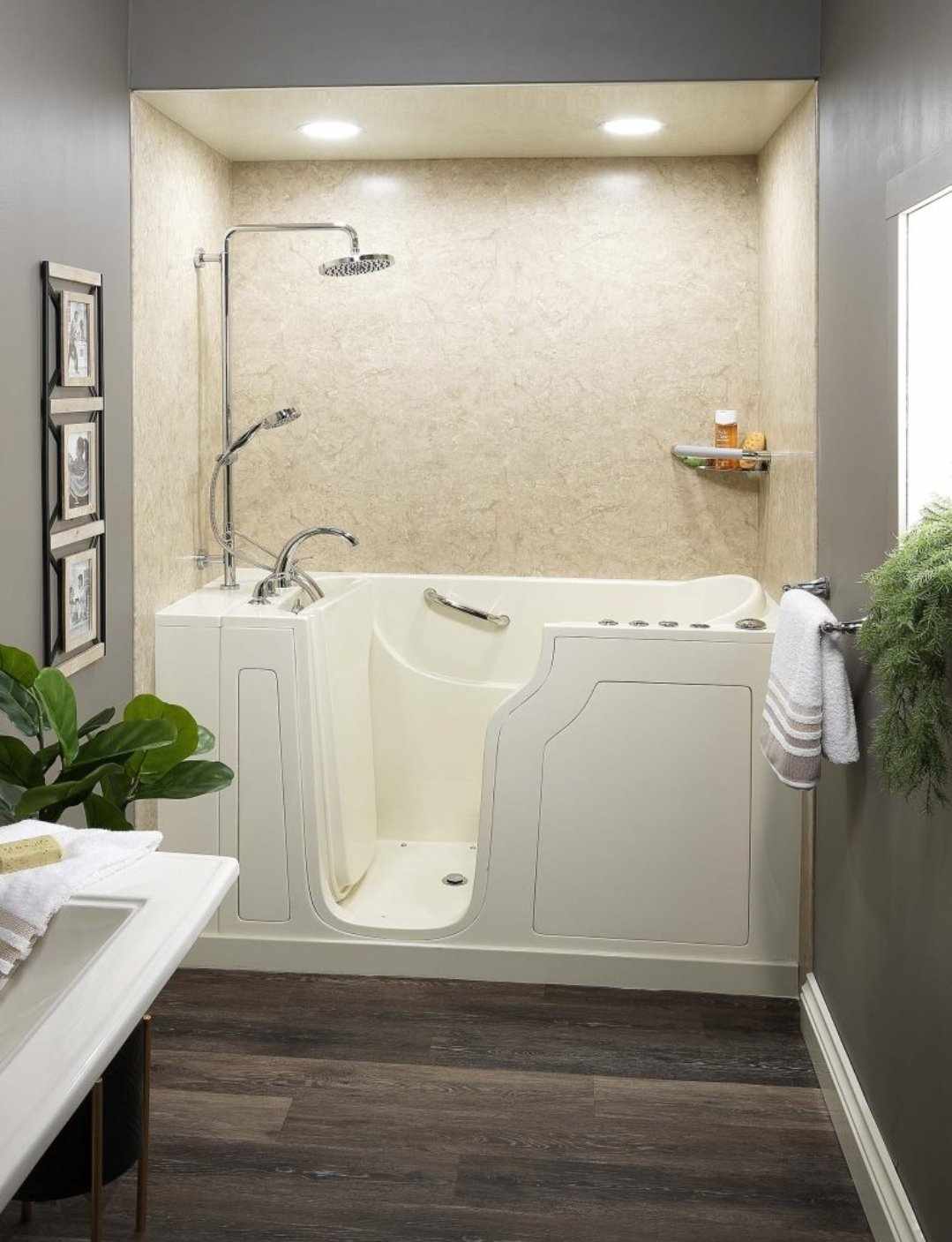
The builder baths get the same treatment as the kitchen, but with an eye on the next twenty years rather than the next buyer. That means a real tiled walk-in shower instead of the fiberglass insert, a quartz-topped vanity sized to the room, and finishes you chose rather than defaulted to. Because you are keeping the home, this is also the moment to build in the aging-in-place infrastructure you will eventually be glad you have: in-wall blocking for future grab bars, a curbless or low-threshold shower entry, lever handles, comfort-height fixtures, and slip-resistant flooring. None of it has to look clinical. It just quietly makes the home work as the years go on. Our walk-in showers page explains the aging-in-place features we build into every shower.
The Contingency Is Smaller on a Newer Home
One advantage of remodeling a newer Box Elder subdivision home versus an older house is that the surprises behind the walls are fewer. In a hundred-year-old home we carry a big contingency because opening a wall reliably reveals abandoned plumbing, outdated wiring, and settled framing. In a 2000s or 2010s Box Elder build, the bones are relatively young and predictable, which keeps the contingency modest, usually in the 5 to 10 percent range. Bruce Miller labels that number clearly in the written line-item quote and hands back whatever we do not spend. You get the certainty of a real budget without paying for problems your house does not have.
One Contractor, One Schedule, One Point of Accountability
A whole-home remodel involves framers, plumbers, electricians, drywallers, tilers, cabinet installers, painters, and flooring crews, and the difference between a project that runs smoothly and one that turns into a nightmare is coordination. Black Hills Premier Interiors is a licensed general contractor, and Bruce has run whole-home remodels for 50 years. You sign one contract, deal with one project manager, get one schedule, and the trades show up in the right order so the tile is not set on a floor that still has to move and the painter does not arrive before the trim is in. The job ends with a single walk-through punch list and a one-year workmanship warranty, not six separate loose ends from six separate contractors.
That single point of accountability is the whole value of a general contractor, and it matters most on a project this size. When you decide to make a Box Elder rotation house into a forever home, you want one person answerable for all of it, from the first scope conversation to the final coat of paint.
Common Questions
How long does a Box Elder whole-home refresh take?
A builder-grade subdivision transformation runs 5 to 9 months, and an aging-in-place whole-home update runs 6 to 10 months. Some remodels can be phased, kitchen first, then baths, then everything else, over a longer window if you want to stay in the home throughout. We build the schedule around your situation.
Is it worth remodeling a builder-grade home instead of moving?
For many Box Elder families deciding to stay as the B-21 mission grows, yes. A whole-home refresh turns the fast-built house you already own into a custom home without the cost, disruption, and uncertainty of buying and moving in a tightening market. You get exactly the home you want in the location you already chose.
Should I do the whole home at once or one room at a time?
For a home you plan to keep, doing it as one coordinated project is usually cheaper and better. The trades mobilize once, the disruption happens in one stretch, and the home is designed as a whole. Piecemeal updates over years cost more and rarely tie together into a coherent result.
Do we need to move out during a whole-home remodel?
For a true whole-home project it is highly recommended, given the dust, noise, and trade sequencing. A phased approach lets you stay and shift between completed and active areas. We work out the living arrangements during the initial scope conversation and plan around your needs.
Do you offer a veteran discount?
Yes. Bruce is a US military veteran and extends a veteran discount on every Box Elder project. In a town built around Ellsworth Air Force Base, serving the military community is personal for us. Mention it at the consultation and it comes off the written quote.
Staying in Box Elder? Let’s Make It Home.
Free in-home consultation with Bruce Miller, a veteran-owned licensed general contractor. 50 years of craftsmanship, serving Box Elder from nearby Rapid City.
Get Free Quote Call (605) 636-2284Read more on our Box Elder service area page, see our project gallery, or learn about Bruce and the team.